OCTI Player & Robot SDK (2001 Legacy Archive)
Preserved 2001–2003 historical documentation for the original Linux/UNIX graphical application and C/C++ Robot SDK created by Charles Chiou for playing and analyzing the strategy board game OCTI.
Modern OCTI Distributions (Android & Windows Qt6)
While this page preserves the original 2001–2003 Linux X11 client and Robot SDK for historical reference, actively maintained modern editions of OCTI with built-in cryptographic self-update and SHA-256 verification are available for Android and 64-bit Windows:
Original Linux/UNIX System & Robot SDK
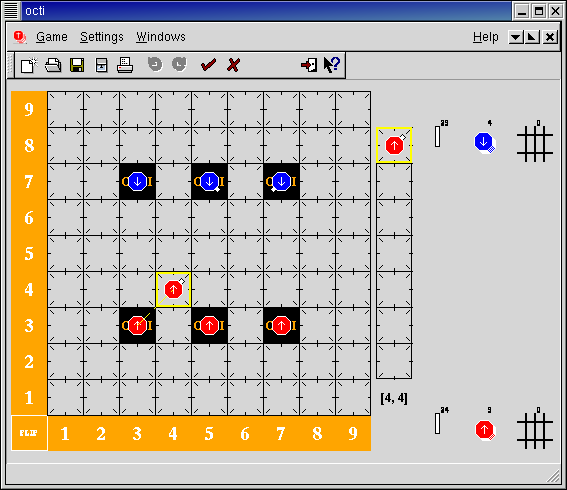
OCTI is a renowned abstract strategy game played on a grid with octagonal pods and insertable direction prongs. The original 2001 OCTI Player application provided a standalone graphical desktop client for Linux and UNIX systems, enabling human vs. computer, human vs. human, and networked multiplayer gameplay.
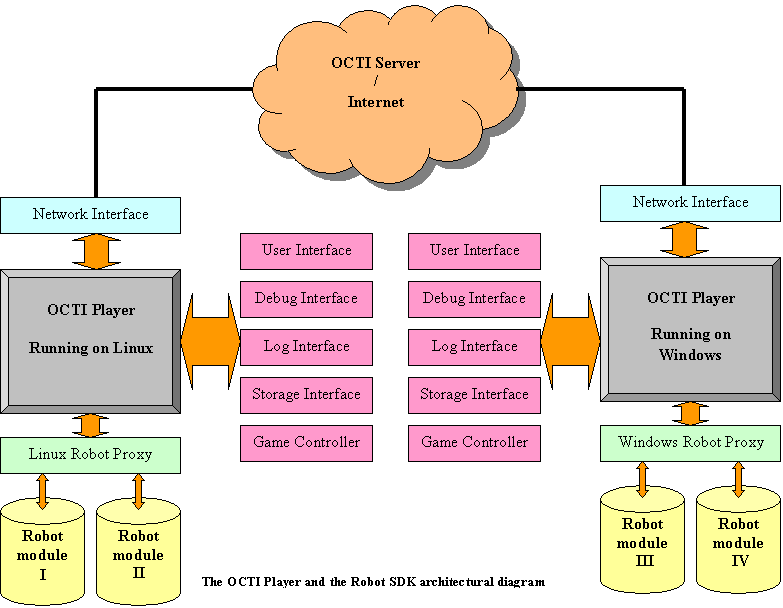
The accompanying OCTI Robot SDK was engineered to provide clean C/C++ APIs for AI bot programmers, supporting alpha-beta minimax search, board evaluation matrices, and move simulation.
Robot SDK Layering
Legacy Linux Desktop Client
Frequently Asked Questions
What makes OCTI strategically unique?
Unlike Chess or Checkers where piece movement capabilities are static, in OCTI players actively dynamically construct their pieces by adding directional arrows (prongs) during play, resulting in deep branching factors and dynamic mobility.
How is the AI robot implemented?
The SDK exposes a standardized evaluation interface. The AI implements alpha-beta pruned minimax searching with heuristic evaluation weights for board dominance, prong diversity, and jump threat analysis.